Metal Displacement Reaction Lab
Dip metal strips into salt solutions and use the reactivity series to predict what is displaced.
- NCERT Activities 1.9 and 3.12
- Table 3.2 (activity series)
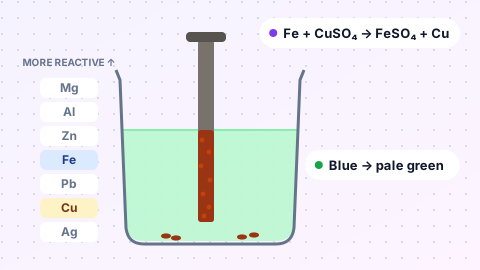
Drag the metal strip down into the solution, or tap it. Drag it back up to try again.
Reactivity series
- K
- Na
- Ca
- Mg
- Al
- Zn
- Festrip
- Pb
- [H]
- Cuin salt
- Hg
- Ag
- Au
Most reactive at the top
CBSE practical results table: Zn, Fe, Cu and Al in sulphate solutions
| Metal | ZnSO4 | FeSO4 | CuSO4 | Al2(SO4)3 |
|---|---|---|---|---|
| Zinc | No reaction | Reacts | Reacts | No reaction |
| Iron | No reaction | No reaction | Reacts | No reaction |
| Copper | No reaction | No reaction | No reaction | No reaction |
| Aluminium | Reacts | Reacts | Reacts | No reaction |
Decreasing order of reactivity: Aluminium > Zinc > Iron > Copper
About the Metal Displacement Reaction Lab
This reactivity series simulation recreates the classic iron nail in copper sulphate experiment from NCERT Activities 1.9 and 3.12. Dip iron, zinc, aluminium, magnesium, copper or silver into a salt solution, predict whether a displacement reaction will take place, and watch the colour of the solution change as the metal coating forms.
Every reaction shows a balanced chemical equation and the observations to write in your practical file. Use it to prepare for the CBSE Class 10 practical on Zn, Fe, Cu and Al with their sulphate solutions, and to arrange the metals in decreasing order of reactivity.
CBSE Class 10 practical
Observing the action of Zn, Fe, Cu and Al on ZnSO₄, FeSO₄, CuSO₄ and Al₂(SO₄)₃ solutions and arranging the metals in decreasing order of reactivity.
Try this
- 1Recreate Activity 3.12: put iron in copper sulphate, then copper in iron sulphate.
- 2Place copper in silver nitrate. Why does a colourless solution turn blue?
- 3Find a metal that displaces every other metal in the list of solutions.
What you will learn
- Use the reactivity series to predict whether displacement will take place.
- Describe the colour changes when an iron nail is placed in copper sulphate solution.
- Write balanced equations for displacement reactions.
Key ideas
- Displacement rule
- Metal A + salt solution of B → salt solution of A + metal B, only when A is more reactive than B.
- Evidence of reaction
- A change in the colour of the solution and a coating on the metal show that a reaction has taken place.
Board exam tip
For Fe + CuSO4, state both observations: the blue solution turns pale green and a reddish-brown coating forms on iron.
Frequently asked questions
What happens when an iron nail is placed in copper sulphate solution?
Iron is more reactive than copper, so it displaces copper: Fe + CuSO₄ → FeSO₄ + Cu. The blue solution fades to pale green and a reddish-brown coating of copper forms on the nail.
Why does copper not react with iron sulphate solution?
Copper is below iron in the reactivity series, so it cannot displace iron from its salt. No colour change or coating is seen.
What is the order of reactivity of Zn, Fe, Cu and Al?
From the displacement results, the decreasing order of reactivity is Al > Zn > Fe > Cu, which matches the activity series in NCERT Table 3.2.