CBSE Class 10 Science Simulations
Try the experiments from your NCERT Science book on screen. Move objects, change values and see the result straight away, then check it against the textbook tables and rules.
10 simulations across 9 chapters, including 6 CBSE practicals. Works on phones, tablets and laptops.
Chapter 1
Chemical Reactions and Equations
Chapter 2
Acids, Bases and Salts
Chapter 3
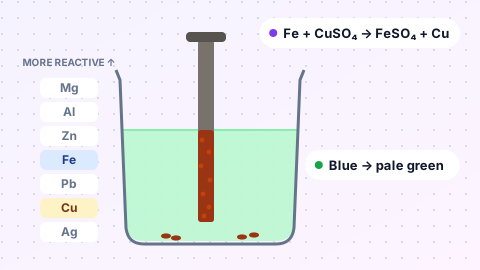
Metals and Non-metals
Chapter 8
Heredity
Chapter 9
Light – Reflection and Refraction
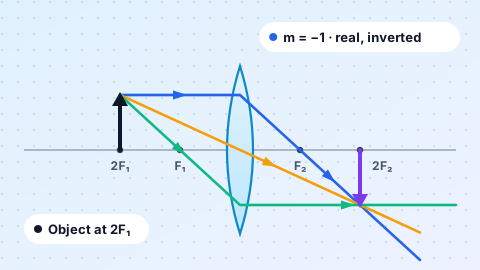
Mirror and Lens Ray Diagram Lab
Drag the object in front of a mirror or lens and watch the principal rays, image and magnification update.
NCERT Tables 9.1, 9.2, 9.4 and 9.5
Open simulation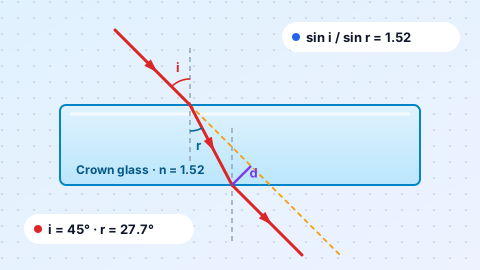
Refraction Through a Glass Slab
Change the angle of incidence and the material to see Snell's law and lateral displacement.
NCERT Activity 9.10 (rectangular glass slab)
Open simulationChapter 10
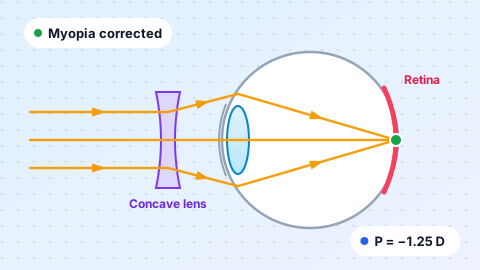
The Human Eye and the Colourful World
Chapter 11
Electricity
Chapter 12
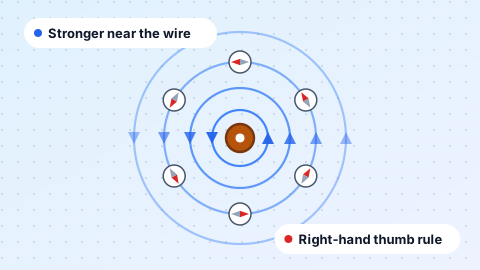
Magnetic Effects of Electric Current
Chapter 13
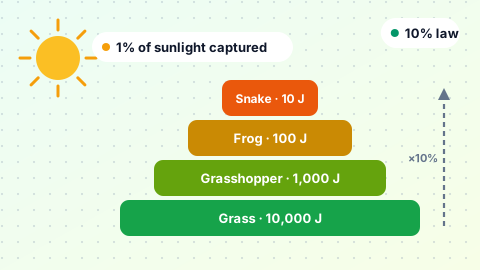
Our Environment
A free Class 10 Science virtual lab
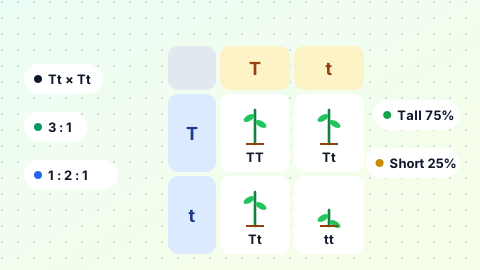
Science is easier to understand when you can see it happen. These CBSE Class 10 Science simulations turn the experiments and diagrams from the NCERT book into interactive models: draw ray diagrams for mirrors and lenses, build series and parallel circuits, test acids and bases with indicators, and follow Mendel's crosses with a Punnett square.
Every simulation is linked to its NCERT chapter, its activities and tables, and the chapter notes and mind map on CraftExam, so you can move from trying an experiment to revising it for the board exam.
CBSE Class 10 practicals you can rehearse online
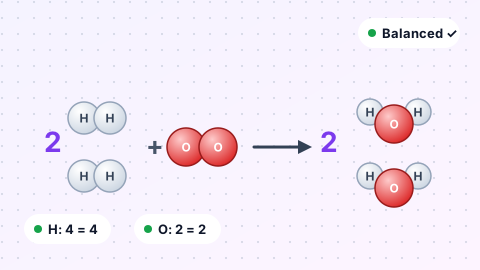
- Chemical Equation Balancer: Performing and classifying four reactions: quicklime with water, heating ferrous sulphate crystals, iron nails in copper sulphate, and sodium sulphate with barium chloride.
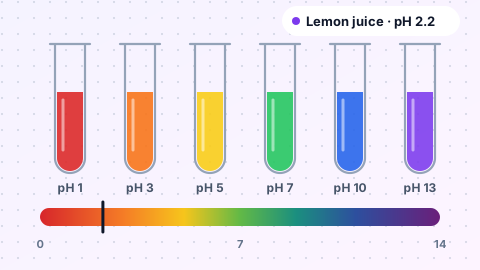
- pH Scale and Indicator Lab: Finding the pH of dilute hydrochloric acid, dilute sodium hydroxide, dilute ethanoic acid, lemon juice, water and dilute sodium hydrogencarbonate solution using pH paper or universal indicator.
- Metal Displacement Reaction Lab: Observing the action of Zn, Fe, Cu and Al on ZnSO₄, FeSO₄, CuSO₄ and Al₂(SO₄)₃ solutions and arranging the metals in decreasing order of reactivity.
- Mirror and Lens Ray Diagram Lab: Finding the focal length of a concave mirror and a convex lens using a distant object. Move the object far away and the image forms close to the focus.
- Refraction Through a Glass Slab: Tracing the path of a ray of light through a rectangular glass slab for different angles of incidence, and measuring the angles of incidence, refraction and emergence.
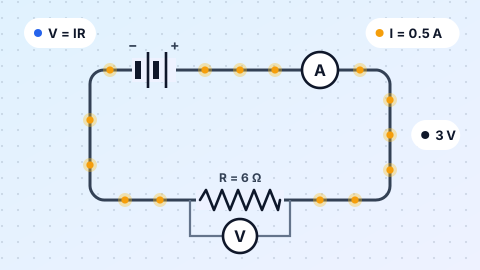
- Ohm's Law and Resistor Combinations Lab: Studying how the potential difference (V) across a resistor depends on the current (I) and plotting a V–I graph, and finding the equivalent resistance of two resistors in series and in parallel.
Questions about the simulations
Are the CraftExam Class 10 Science simulations free?
Yes. All the simulations are free to use in your browser, with no login or download, on a phone, tablet or laptop.
Do the simulations follow the NCERT book and the CBSE syllabus?
Each simulation is linked to an NCERT Class 10 Science chapter and to the activities, tables or figures it recreates. Several of them match practicals in the CBSE 2025-26 Class 10 Science syllabus.
Can teachers use these simulations in class?
Yes. Teachers can demonstrate an experiment on a projector or smart board, and students can repeat it at home on their own devices.
Do the simulations replace the practical exam in the school lab?
No. They help you prepare and revise, but the CBSE practical examination is done in the school laboratory under your teacher's guidance.
Simulations use simplified models of the NCERT experiments. Always follow your teacher's instructions in the real laboratory. Content is created for learning and exam preparation support. Students should refer to their school textbooks and teacher guidance for final exam preparation.