Mirror and Lens Ray Diagram Lab
Drag the object in front of a mirror or lens and watch the principal rays, image and magnification update.
- NCERT Tables 9.1, 9.2, 9.4 and 9.5
- Mirror formula, lens formula and power of a lens
Drag the object along the axis, or tap where you want it. Drag the blue F point to change the focal length.
- Parallel to the axis
- Through or towards F
- Through P or O
- Extended back (virtual image)
Heights are drawn larger than distances so the rays are easy to see. Distances follow the New Cartesian sign convention.
Object distance u
−30 cm
Image distance v
−20 cm
Focal length f
−12 cm
Magnification m
−0.67
Image height −2 cm
Nature
Real, inverted
| Position of object | Position of image | Size | Nature |
|---|---|---|---|
| At infinity | At the focus F | Highly diminished, point-sized | Real and inverted |
| Beyond C | Between F and C | Diminished | Real and inverted |
| At C | At C | Same size | Real and inverted |
| Between C and F | Beyond C | Enlarged | Real and inverted |
| At F | At infinity | Image would not be formed | Real and inverted |
| Between P and F | Behind the mirror | Enlarged | Virtual and erect |
About the Mirror and Lens Ray Diagram Lab
This ray diagram simulator covers every case of image formation by spherical mirrors and lenses in CBSE Class 10 Light – Reflection and Refraction. Pick a concave mirror, convex mirror, convex lens or concave lens, drag the object along the principal axis and watch the principal rays locate the image.
The simulation calculates the image distance with the mirror formula or lens formula using the New Cartesian sign convention, and shows the magnification, the power of the lens and the nature of the image. The matching row of NCERT Table 9.1, 9.2, 9.4 or 9.5 is highlighted, so you can revise every case quickly.
CBSE Class 10 practical
Finding the focal length of a concave mirror and a convex lens using a distant object. Move the object far away and the image forms close to the focus.
Try this
- 1With a concave mirror, move the object from beyond C to between P and F. Watch the highlighted row of Table 9.1.
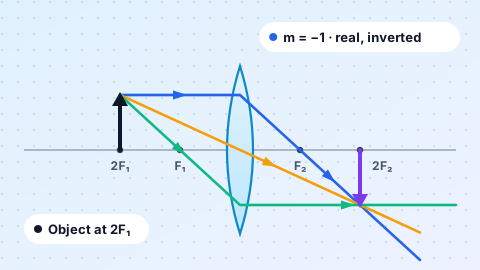
- 2Place the object exactly at 2F1 of a convex lens. What is the magnification?
- 3Switch to a convex mirror. Can you ever get a real image?
What you will learn
- Draw ray diagrams using the principal rays of mirrors and lenses.
- Predict the position, size and nature of the image for each object position.
- Use the New Cartesian sign convention with the mirror and lens formulae.
Key ideas
- Mirror formula
- 1/v + 1/u = 1/f, with magnification m = −v/u.
- Lens formula
- 1/v − 1/u = 1/f, with magnification m = v/u and power P = 1/f (f in metres).
Board exam tip
A negative magnification means a real, inverted image. A positive magnification means a virtual, erect image.
Frequently asked questions
Where is the image formed when the object is at 2F1 of a convex lens?
The image forms at 2F2 on the other side of the lens. It is real, inverted and the same size as the object, so the magnification is −1.
When does a concave mirror form a virtual image?
Only when the object is between the pole P and the focus F. The image is then formed behind the mirror and is virtual, erect and enlarged.
What does a negative magnification mean?
A negative magnification means the image is real and inverted, and a positive one means it is virtual and erect. If the value is more than 1 the image is enlarged; if it is less than 1 the image is diminished.