Chapter Hub
Light - Reflection and Refraction
This chapter builds the foundation of geometrical optics by showing how light reflects from mirrors and refracts through different media. You should learn the ray rules, sign conventions, and standard image cases because most CBSE questions come from diagrams and numericals.
Difficulty
Medium
Study time
80-100 min
Plan by time
Pick the window that matches what you have right now.
If you have 15 min
Last-pass revision
Skim the Quick Revision table — definitions, formulas, and the traps board examiners reuse.
Open Quick RevisionIf you have 45 min
Targeted practice
Read the high-priority concepts, then take the chapter MCQ quiz to find weak spots.
Start MCQ QuizIf you have 80 min
First full pass
Walk every concept in chapter order, then revise and quiz. Best for the first time you study this chapter.
Open Key ConceptsChapter Learning Map
Start with one of the buckets below, then open the full map when you want the complete concept roadmap.
Key Concepts
Concepts grouped the way the chapter is taught — open the group that matches what you want to revise.
Reflection and Mirrors
high priorityCovers Reflection, Laws Of Reflection, Spherical Mirror, Focal Length and Mirror Formula.
Reflection
Reflection is the bouncing back of light into the same medium after it strikes a surface.
Laws Of Reflection
The laws of reflection state that the incident ray, reflected ray, and normal lie in one plane, and angle of incidence equals angle of reflection.
Spherical Mirror
A spherical mirror is a mirror whose reflecting surface forms part of a sphere.
Focal Length
The focal length is the distance between the pole of a mirror and its principal focus.
Mirror Formula
The mirror formula relates object distance, image distance, and focal length for spherical mirrors.
Refraction and Lenses
medium priorityCovers Refraction, Refractive Index, Lens Formula, Power Of Lens and Image By Convex Lens.
Refraction
Refraction is the bending of light when it passes from one medium to another because its speed changes.
Refractive Index
Refractive index tells us how much a medium slows down light compared with vacuum or air, and how strongly it bends light.
Lens Formula
The lens formula relates object distance, image distance, and focal length for a thin lens.
Power Of Lens
Power of a lens is the measure of how strongly it converges or diverges light.
Image By Convex Lens
A convex lens can form real or virtual images depending on where the object is placed.
Virtual lab
Light - Reflection and Refraction simulations
Try the experiment yourself: change the values, see the result straight away, then check it against the NCERT book.
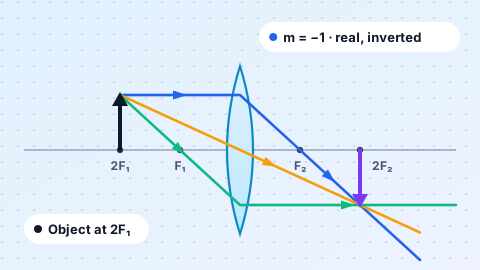
Mirror and Lens Ray Diagram Lab
Drag the object in front of a mirror or lens and watch the principal rays, image and magnification update.
CBSE practical
Open simulation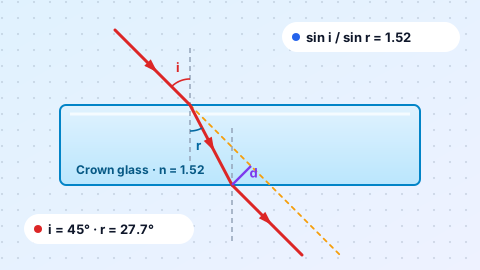
Refraction Through a Glass Slab
Change the angle of incidence and the material to see Snell's law and lateral displacement.
CBSE practical
Open simulationExam Intelligence
The traps that cost marks in this chapter, and how its main concepts turn up in the paper.
Common Traps
- Measuring angles from the mirror surface instead of the normal.
- Forgetting the Cartesian sign convention in mirror and lens numericals.
- Using centimetres directly in lens power calculations.
- Confusing concave and convex mirrors by shape only.
- Assuming every convex lens image is real.
How CBSE Asks This Chapter
- Reflection
Students may be asked to identify the process, explain image formation in a mirror, or draw the reflected ray.
- Laws Of Reflection
You may be asked to state the laws, complete a ray diagram, or find the angle of reflection from a given angle of incidence.
- Spherical Mirror
Questions ask you to identify mirror type from its use, label parts of the mirror, or predict image nature.
- Focal Length
You may be asked to calculate f from R, identify the focus position, or explain why rays parallel to the axis meet at the focus.
Quick Revision
Concept, formula or equation to remember, and the trap that loses marks — in one scannable view.
Remember
Reflection follows the basic idea that the angle of incidence equals the angle of reflection, measured from the normal.Trap to avoid
Students often think the light enters the surface and changes medium, but reflection keeps light in the same medium.
Remember
Law 1: incident ray, reflected ray, and normal lie in the same plane.Trap to avoid
Students often measure the angle with the mirror surface instead of the normal.
Remember
For a spherical mirror, the principal focus lies on the principal axis; for a small aperture mirror, focal length is half the radius of curvature, f = R/2.Trap to avoid
Students often mix up concave and convex by looking only at the shape, not the reflecting surface.
Remember
For small spherical mirrors, f = R/2.Trap to avoid
Students sometimes measure from the centre of curvature or from the mirror edge instead of from the pole.
Remember
Mirror formula: 1/f = 1/v + 1/u, with distances measured from the pole using Cartesian sign convention.Trap to avoid
Students often insert all distances as positive numbers and then get the wrong image position.
Remember
Refraction occurs because light changes speed on entering a different medium; bending towards the normal means the new medium is optically denser.Trap to avoid
Students think the light ray bends because the object itself changes shape.
Remember
Refractive index n = c/v for absolute refractive index, and for a given pair of media n = sin i / sin r.Trap to avoid
Students mix up refractive index with density alone.
Remember
Lens formula: 1/f = 1/v - 1/u, with distances measured from the optical centre using the Cartesian sign convention.Trap to avoid
Students often use 1/f = 1/u + 1/v or forget that object distance is negative in front of the lens.
Remember
Power of lens P = 1/f, where f is in metres.Trap to avoid
Students forget to convert centimetres into metres before finding power.
Remember
A ray parallel to the principal axis passes through the focus, and a ray through the optical centre goes undeviated.Trap to avoid
Students often think every convex lens image is real.
| Concept | Remember | Trap to avoid |
|---|---|---|
| Reflection | Reflection follows the basic idea that the angle of incidence equals the angle of reflection, measured from the normal. | Students often think the light enters the surface and changes medium, but reflection keeps light in the same medium. |
| Laws Of Reflection | Law 1: incident ray, reflected ray, and normal lie in the same plane. | Students often measure the angle with the mirror surface instead of the normal. |
| Spherical Mirror | For a spherical mirror, the principal focus lies on the principal axis; for a small aperture mirror, focal length is half the radius of curvature, f = R/2. | Students often mix up concave and convex by looking only at the shape, not the reflecting surface. |
| Focal Length | For small spherical mirrors, f = R/2. | Students sometimes measure from the centre of curvature or from the mirror edge instead of from the pole. |
| Mirror Formula | Mirror formula: 1/f = 1/v + 1/u, with distances measured from the pole using Cartesian sign convention. | Students often insert all distances as positive numbers and then get the wrong image position. |
| Refraction | Refraction occurs because light changes speed on entering a different medium; bending towards the normal means the new medium is optically denser. | Students think the light ray bends because the object itself changes shape. |
| Refractive Index | Refractive index n = c/v for absolute refractive index, and for a given pair of media n = sin i / sin r. | Students mix up refractive index with density alone. |
| Lens Formula | Lens formula: 1/f = 1/v - 1/u, with distances measured from the optical centre using the Cartesian sign convention. | Students often use 1/f = 1/u + 1/v or forget that object distance is negative in front of the lens. |
| Power Of Lens | Power of lens P = 1/f, where f is in metres. | Students forget to convert centimetres into metres before finding power. |
| Image By Convex Lens | A ray parallel to the principal axis passes through the focus, and a ray through the optical centre goes undeviated. | Students often think every convex lens image is real. |
Practice
Use short concept checks first, then move into the full chapter test.
Free Chapter MCQ Quiz
Try a 15-question quiz from this chapter. Get instant score and unlock concept-wise analytics.
Help improve this page
Found something confusing, incorrect, or missing?