Chapter Hub
Magnetic Effects of Electric Current
This chapter explains how electric current produces magnetism and how magnetic fields can be used in devices like motors and generators. You should focus on direction rules, field patterns, electromagnets, and the difference between current effects in everyday devices. For Class 10 exams, this chapter is usually asked through diagrams, reason-based questions, short numericals on devices, and application-based MCQs. A clear grip on field lines, thumb rules, motor action, and induction helps in both objective and long-answer practice.
Difficulty
Medium
Study time
80-100 min
Plan by time
Pick the window that matches what you have right now.
If you have 15 min
Last-pass revision
Skim the Quick Revision table — definitions, formulas, and the traps board examiners reuse.
Open Quick RevisionIf you have 45 min
Targeted practice
Read the high-priority concepts, then take the chapter MCQ quiz to find weak spots.
Start MCQ QuizIf you have 80 min
First full pass
Walk every concept in chapter order, then revise and quiz. Best for the first time you study this chapter.
Open Key ConceptsChapter Learning Map
Start with one of the buckets below, then open the full map when you want the complete concept roadmap.
Magnetic field basics
Covers Magnetic Field and Field Lines.
Open mapDirection rules
Covers Right Hand Thumb Rule, Fleming's left hand rule and Fleming's right hand rule.
Open mapCurrent and magnet devices
Covers Solenoid, Electromagnet and Electric Motor.
Open mapInduction and supply types
Covers Electromagnetic Induction and AC and DC.
Open mapKey Concepts
Concepts grouped the way the chapter is taught — open the group that matches what you want to revise.
Magnetic field basics
high priorityCovers Magnetic Field and Field Lines.
Magnetic Field
A magnetic field is the region around a magnet or a current-carrying conductor where magnetic force can be felt.
Field Lines
Field lines are imaginary lines used to show the shape, direction, and strength of a magnetic field.
Direction rules
high priorityCovers Right Hand Thumb Rule, Fleming's left hand rule and Fleming's right hand rule.
Right Hand Thumb Rule
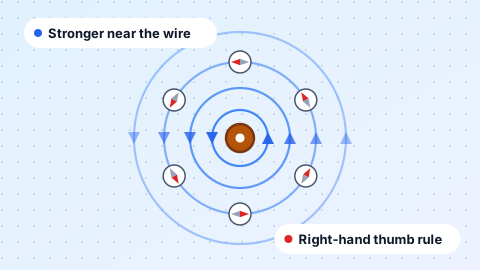
The right hand thumb rule is a rule used to find the direction of the magnetic field around a straight current-carrying conductor.
Fleming's left hand rule
Fleming's left hand rule helps find the direction of force on a current-carrying conductor placed in a magnetic field.
Fleming's right hand rule
Fleming's right hand rule helps find the direction of induced current when a conductor moves in a magnetic field.
Current and magnet devices
high priorityCovers Solenoid, Electromagnet and Electric Motor.
Solenoid
A solenoid is a long cylindrical coil of many turns of insulated wire.
Electromagnet
An electromagnet is a temporary magnet produced by electric current through a coil, usually wound around a soft iron core.
Electric Motor
An electric motor is a device that converts electrical energy into mechanical energy by using the force on a current-carrying coil in a magnetic field.
Induction and supply types
medium priorityCovers Electromagnetic Induction and AC and DC.
Electromagnetic Induction
Electromagnetic induction is the production of induced current in a conductor when the magnetic field around it changes.
AC and DC
AC is alternating current, which changes direction periodically, while DC is direct current, which flows in one direction only.
Virtual lab
Magnetic Effects of Electric Current simulation
Try the experiment yourself: change the values, see the result straight away, then check it against the NCERT book.
Exam Intelligence
The traps that cost marks in this chapter, and how its main concepts turn up in the paper.
Common Traps
- Treating magnetic field as only inside the magnet instead of around it too.
- Drawing crossing magnetic field lines in the same region.
- Using the left hand for current around a straight wire instead of the right hand.
- Forgetting that a solenoid becomes magnetic only when current flows.
- Confusing a permanent magnet with an electromagnet.
- Mixing up AC and DC by strength instead of direction change.
How CBSE Asks This Chapter
- Magnetic Field
Explain what magnetic field means, or describe the observation when a compass is placed near a magnet or current-carrying conductor.
- Field Lines
Draw magnetic field lines around a bar magnet, or state what field-line spacing tells us about strength.
- Right Hand Thumb Rule
State the rule, identify the current direction, or tell the direction of magnetic field around a straight conductor.
- Solenoid
Define a solenoid, describe its field pattern, or explain why it behaves like a bar magnet when current flows.
Quick Revision
Concept, formula or equation to remember, and the trap that loses marks — in one scannable view.
Remember
A magnetic field is represented by field lines; closer lines mean a stronger field, and the direction outside a magnet is from north pole to south pole.Trap to avoid
Many students think the magnetic field exists only inside the magnet.
Remember
Field lines outside a magnet go from north pole to south pole, and no two field lines intersect each other.Trap to avoid
Students often think field lines are real wires or tracks.
Remember
Thumb points in current direction; curled fingers give the direction of circular magnetic field lines around a straight conductor.Trap to avoid
A common mistake is using the left hand or confusing the thumb direction with the magnetic field direction.
Remember
A current-carrying solenoid behaves like a bar magnet, with a strong and nearly uniform field inside the coil.Trap to avoid
Students often think a solenoid is a magnet by itself.
Remember
Strength of an electromagnet increases with current, number of turns, and use of a soft iron core.Trap to avoid
Students often confuse an electromagnet with a permanent magnet.
Remember
Forefinger = magnetic field, middle finger = current, thumb = force or motion, all mutually perpendicular.Trap to avoid
Students often use the right hand here or mix up the directions of current and force.
Remember
Motor action depends on force on a current-carrying conductor in a magnetic field, explained by Fleming's left hand rule.Trap to avoid
Students often say the motor itself produces electricity.
Remember
An induced current is produced only when there is a change in magnetic field linked with the conductor or coil.Trap to avoid
Students often think a magnet alone produces current at rest.
Remember
Forefinger = magnetic field, thumb = motion of conductor, middle finger = induced current, all at right angles.Trap to avoid
Students often use the left hand here or mix the directions of motion and current.
Remember
AC changes direction periodically; DC flows in one direction.Trap to avoid
Students often think AC and DC differ only in strength.
| Concept | Remember | Trap to avoid |
|---|---|---|
| Magnetic Field | A magnetic field is represented by field lines; closer lines mean a stronger field, and the direction outside a magnet is from north pole to south pole. | Many students think the magnetic field exists only inside the magnet. |
| Field Lines | Field lines outside a magnet go from north pole to south pole, and no two field lines intersect each other. | Students often think field lines are real wires or tracks. |
| Right Hand Thumb Rule | Thumb points in current direction; curled fingers give the direction of circular magnetic field lines around a straight conductor. | A common mistake is using the left hand or confusing the thumb direction with the magnetic field direction. |
| Solenoid | A current-carrying solenoid behaves like a bar magnet, with a strong and nearly uniform field inside the coil. | Students often think a solenoid is a magnet by itself. |
| Electromagnet | Strength of an electromagnet increases with current, number of turns, and use of a soft iron core. | Students often confuse an electromagnet with a permanent magnet. |
| Fleming's left hand rule | Forefinger = magnetic field, middle finger = current, thumb = force or motion, all mutually perpendicular. | Students often use the right hand here or mix up the directions of current and force. |
| Electric Motor | Motor action depends on force on a current-carrying conductor in a magnetic field, explained by Fleming's left hand rule. | Students often say the motor itself produces electricity. |
| Electromagnetic Induction | An induced current is produced only when there is a change in magnetic field linked with the conductor or coil. | Students often think a magnet alone produces current at rest. |
| Fleming's right hand rule | Forefinger = magnetic field, thumb = motion of conductor, middle finger = induced current, all at right angles. | Students often use the left hand here or mix the directions of motion and current. |
| AC and DC | AC changes direction periodically; DC flows in one direction. | Students often think AC and DC differ only in strength. |
Practice
Use short concept checks first, then move into the full chapter test.
Free Chapter MCQ Quiz
Try a 15-question quiz from this chapter. Get instant score and unlock concept-wise analytics.
Help improve this page
Found something confusing, incorrect, or missing?