Chapter Hub
Electricity
This chapter builds the base ideas of electric current, potential difference, resistance, and Ohm's law. You should understand the meaning of each quantity, its unit, and the relation between voltage, current, and resistance before moving to numericals. The chapter then connects these ideas to series and parallel circuits, heating effect, electric power, commercial energy units, and fuse safety. These topics are commonly asked in school exams through numericals, reasoning questions, and everyday circuit examples.
Difficulty
Medium
Study time
80-100 min
Plan by time
Pick the window that matches what you have right now.
If you have 15 min
Last-pass revision
Skim the Quick Revision table — definitions, formulas, and the traps board examiners reuse.
Open Quick RevisionIf you have 45 min
Targeted practice
Read the high-priority concepts, then take the chapter MCQ quiz to find weak spots.
Start MCQ QuizIf you have 80 min
First full pass
Walk every concept in chapter order, then revise and quiz. Best for the first time you study this chapter.
Open Key ConceptsChapter Learning Map
Start with one of the buckets below, then open the full map when you want the complete concept roadmap.
Basic quantities
Covers Electric Current, Potential Difference, Resistance and Ohm's law.
Open mapCircuit connections
Covers Series Combination and Parallel Combination.
Open mapEnergy and safety
Covers Heating Effect, Electric Power, Commercial Unit and Fuse.
Open mapKey Concepts
Concepts grouped the way the chapter is taught — open the group that matches what you want to revise.
Basic quantities
high priorityCovers Electric Current, Potential Difference, Resistance and Ohm's law.
Electric Current
Electric current is the rate at which electric charge flows through a conductor.
Potential Difference
Potential difference is the work done per unit charge between two points in a circuit.
Resistance
Resistance is the opposition offered by a conductor to the flow of electric current.
Ohm's law
Ohm's law states that at constant temperature, the current through a conductor is directly proportional to the potential difference across it.
Circuit connections
high priorityCovers Series Combination and Parallel Combination.
Series Combination
In a series combination, components are connected end to end in a single path for current.
Parallel Combination
In a parallel combination, components are connected in separate branches across the same two points.
Energy and safety
medium priorityCovers Heating Effect, Electric Power, Commercial Unit and Fuse.
Heating Effect
The heating effect of electric current is the production of heat when current passes through a conductor with resistance.
Electric Power
Electric power is the rate at which electrical energy is used or converted in a circuit.
Commercial Unit
The commercial unit of electrical energy is kilowatt-hour, written as kWh.
Fuse
A fuse is a safety device connected in a circuit to protect it from excessive current.
Virtual lab
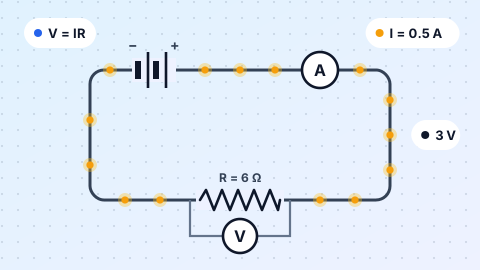
Electricity simulation
Try the experiment yourself: change the values, see the result straight away, then check it against the NCERT book.
Exam Intelligence
The traps that cost marks in this chapter, and how its main concepts turn up in the paper.
Common Traps
- Using charge as current instead of dividing by time
- Confusing potential difference with current or resistance
- Using Ohm's law without checking constant temperature
- Thinking longer wires have less resistance
- Adding resistances directly in parallel circuits
- Splitting current in a series circuit
- Ignoring the square of current in heating effect
- Confusing power with energy or kWh with kW
How CBSE Asks This Chapter
- Electric Current
Usually asked as a short numerical using charge and time, or as a concept question on the meaning of ampere.
- Potential Difference
Often asked as a numerical using energy and charge, or as a statement-based question about what voltage means.
- Ohm's law
Commonly asked as a numerical, a V-I graph question, or a small reasoning question about proportional change.
- Resistance
Asked as comparison questions, numerical questions using V and I, or reasoning questions about wire size and material.
Quick Revision
Concept, formula or equation to remember, and the trap that loses marks — in one scannable view.
Remember
I = Q/t, where I is current, Q is charge, and t is time.Trap to avoid
Many students write the total charge as current instead of dividing charge by time.
Remember
V = W/Q, where V is potential difference, W is work done or energy, and Q is charge.Trap to avoid
Students often confuse potential difference with current or treat voltage as total energy.
Remember
V = IR, so R = V/I and I = V/R.Trap to avoid
Students sometimes use the formula without keeping temperature constant or swap the quantities wrongly.
Remember
R = V/I.Trap to avoid
Students often think resistance is the amount of current, not the opposition to current.
Remember
For series resistors, Rs = R1 + R2 + R3 ... and current is the same through all components.Trap to avoid
Students often think current divides in series, which is actually the rule for parallel branches.
Remember
For parallel resistors, 1/Rp = 1/R1 + 1/R2 + 1/R3 ... and the voltage across each branch is the same.Trap to avoid
Students often add resistances directly in parallel or think current is the same in every branch.
Remember
H = I2Rt, where H is heat produced, I is current, R is resistance, and t is time.Trap to avoid
Students often think heating depends only on time and forget the strong effect of current.
Remember
P = VI, P = I2R, and P = V2/R.Trap to avoid
Students often confuse power with total energy or think a larger power value means more electricity stored.
Remember
Electrical energy, E = P x t.Trap to avoid
Students often confuse kWh with kW and forget that time must be included.
Remember
A fuse is connected in series in the live wire.Trap to avoid
Students sometimes place the fuse in parallel or think it allows extra current to pass safely.
| Concept | Remember | Trap to avoid |
|---|---|---|
| Electric Current | I = Q/t, where I is current, Q is charge, and t is time. | Many students write the total charge as current instead of dividing charge by time. |
| Potential Difference | V = W/Q, where V is potential difference, W is work done or energy, and Q is charge. | Students often confuse potential difference with current or treat voltage as total energy. |
| Ohm's law | V = IR, so R = V/I and I = V/R. | Students sometimes use the formula without keeping temperature constant or swap the quantities wrongly. |
| Resistance | R = V/I. | Students often think resistance is the amount of current, not the opposition to current. |
| Series Combination | For series resistors, Rs = R1 + R2 + R3 ... and current is the same through all components. | Students often think current divides in series, which is actually the rule for parallel branches. |
| Parallel Combination | For parallel resistors, 1/Rp = 1/R1 + 1/R2 + 1/R3 ... and the voltage across each branch is the same. | Students often add resistances directly in parallel or think current is the same in every branch. |
| Heating Effect | H = I2Rt, where H is heat produced, I is current, R is resistance, and t is time. | Students often think heating depends only on time and forget the strong effect of current. |
| Electric Power | P = VI, P = I2R, and P = V2/R. | Students often confuse power with total energy or think a larger power value means more electricity stored. |
| Commercial Unit | Electrical energy, E = P x t. | Students often confuse kWh with kW and forget that time must be included. |
| Fuse | A fuse is connected in series in the live wire. | Students sometimes place the fuse in parallel or think it allows extra current to pass safely. |
Practice
Use short concept checks first, then move into the full chapter test.
Free Chapter MCQ Quiz
Try a 15-question quiz from this chapter. Get instant score and unlock concept-wise analytics.
Help improve this page
Found something confusing, incorrect, or missing?