Chapter Hub
The Human Eye and the Colourful World
This chapter links how the eye sees with how light behaves in air, water, and glass. A student should understand the eye lens, the retina, common vision defects, and the nature of light-based effects such as dispersion, scattering, rainbow formation, and atmospheric refraction. For CBSE Class 10, the most useful approach is to connect every idea with a reason, a ray diagram, and a daily-life example. Many exam questions ask for the cause of a defect, the correct lens used for correction, or the explanation of a natural phenomenon seen in the sky.
Difficulty
Medium
Study time
80-100 min
Plan by time
Pick the window that matches what you have right now.
If you have 15 min
Last-pass revision
Skim the Quick Revision table — definitions, formulas, and the traps board examiners reuse.
Open Quick RevisionIf you have 45 min
Targeted practice
Read the high-priority concepts, then take the chapter MCQ quiz to find weak spots.
Start MCQ QuizIf you have 80 min
First full pass
Walk every concept in chapter order, then revise and quiz. Best for the first time you study this chapter.
Open Key ConceptsChapter Learning Map
Start with one of the buckets below, then open the full map when you want the complete concept roadmap.
Key Concepts
Concepts grouped the way the chapter is taught — open the group that matches what you want to revise.
Human eye and vision
high priorityCovers Accommodation, Near Point, Myopia, Hypermetropia and Presbyopia.
Accommodation
Accommodation is the ability of the eye lens to change its curvature so that objects at different distances are seen clearly.
Near Point
The near point is the nearest distance at which an object can be seen clearly without strain.
Myopia
Myopia is a defect in which a person sees nearby objects clearly but distant objects appear blurred.
Hypermetropia
Hypermetropia is a defect in which a person sees distant objects clearly but nearby objects appear blurred.
Presbyopia
Presbyopia is an age-related defect in which the power of accommodation decreases and near vision becomes difficult.
Prism and sky phenomena
medium priorityCovers Dispersion, Rainbow, Atmospheric Refraction, Scattering and Tyndall effect.
Dispersion
Dispersion is the splitting of white light into its constituent colors when it passes through a prism or similar transparent medium.
Rainbow
A rainbow is a natural spectrum of sunlight seen in the sky after dispersion, refraction, and internal reflection in water droplets.
Atmospheric Refraction
Atmospheric refraction is the bending of light by layers of air in the Earth's atmosphere because the air density changes with height.
Scattering
Scattering is the redirection of light in many directions when light hits tiny particles in a medium.
Tyndall effect
The Tyndall effect is the scattering of light by colloidal particles, making the path of a light beam visible.
Virtual lab
The Human Eye and the Colourful World simulation
Try the experiment yourself: change the values, see the result straight away, then check it against the NCERT book.
Exam Intelligence
The traps that cost marks in this chapter, and how its main concepts turn up in the paper.
Common Traps
- Mixing up myopia and hypermetropia lenses.
- Calling the near point the far point.
- Saying the prism creates colors instead of separating them.
- Saying a rainbow is painted in the sky by clouds.
- Confusing atmospheric refraction with reflection.
- Saying the sky is blue because the atmosphere itself is blue.
- Using absorption instead of scattering for the Tyndall effect.
How CBSE Asks This Chapter
- Accommodation
Explain how the eye adjusts its power to see objects at different distances. A ray diagram may also be asked with labels.
- Near Point
State the definition of near point, give the standard value for a normal eye, or identify the effect of a changed near point in a case-based question.
- Myopia
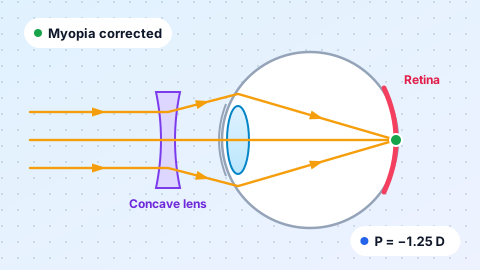
Explain the defect, identify the lens used for correction, or draw a ray diagram showing the corrected image position.
- Hypermetropia
Explain the defect and its correction, or identify the lens in a case where nearby reading is difficult.
Quick Revision
Concept, formula or equation to remember, and the trap that loses marks — in one scannable view.
Remember
The lens changes focal length by changing curvature; this is controlled by ciliary muscles.Trap to avoid
Many students think the eye moves forward and backward to focus.
Remember
For a normal adult eye, the near point is approximately 25 cm.Trap to avoid
Students often think the near point is the closest distance for any eye, but it is the closest clear distance for a particular eye, and it can vary.
Remember
Myopia correction uses a concave lens of suitable focal length to reduce the eye's converging power.Trap to avoid
Students often say myopia means 'short sightedness' but forget to mention that the image of distant objects forms in front of the retina.
Remember
Hypermetropia correction uses a convex lens of suitable focal length to increase the eye's converging power.Trap to avoid
Students often reverse myopia and hypermetropia and choose the wrong corrective lens.
Remember
Presbyopia is corrected by lenses that help near vision, often bifocal lenses when distance vision is also affected.Trap to avoid
Students often think presbyopia is the same as myopia.
Remember
Dispersion happens because different colors have different refractive indices in the same medium.Trap to avoid
Students sometimes say a prism creates colors from nothing.
Remember
Rainbow formation requires dispersion, refraction, and internal reflection in spherical water droplets.Trap to avoid
Students often think a rainbow appears only because of rain and sunlight together.
Remember
Light bends because the refractive index of air increases toward denser lower layers.Trap to avoid
Students often think atmospheric refraction is the same as reflection.
Remember
Shorter wavelength light is scattered more strongly than longer wavelength light in the atmosphere.Trap to avoid
Students often think the sky is blue because the atmosphere itself is blue.
Remember
Tyndall effect is a scattering phenomenon caused by fine particles in a medium.Trap to avoid
Students often think the Tyndall effect is the same as ordinary reflection.
| Concept | Remember | Trap to avoid |
|---|---|---|
| Accommodation | The lens changes focal length by changing curvature; this is controlled by ciliary muscles. | Many students think the eye moves forward and backward to focus. |
| Near Point | For a normal adult eye, the near point is approximately 25 cm. | Students often think the near point is the closest distance for any eye, but it is the closest clear distance for a particular eye, and it can vary. |
| Myopia | Myopia correction uses a concave lens of suitable focal length to reduce the eye's converging power. | Students often say myopia means 'short sightedness' but forget to mention that the image of distant objects forms in front of the retina. |
| Hypermetropia | Hypermetropia correction uses a convex lens of suitable focal length to increase the eye's converging power. | Students often reverse myopia and hypermetropia and choose the wrong corrective lens. |
| Presbyopia | Presbyopia is corrected by lenses that help near vision, often bifocal lenses when distance vision is also affected. | Students often think presbyopia is the same as myopia. |
| Dispersion | Dispersion happens because different colors have different refractive indices in the same medium. | Students sometimes say a prism creates colors from nothing. |
| Rainbow | Rainbow formation requires dispersion, refraction, and internal reflection in spherical water droplets. | Students often think a rainbow appears only because of rain and sunlight together. |
| Atmospheric Refraction | Light bends because the refractive index of air increases toward denser lower layers. | Students often think atmospheric refraction is the same as reflection. |
| Scattering | Shorter wavelength light is scattered more strongly than longer wavelength light in the atmosphere. | Students often think the sky is blue because the atmosphere itself is blue. |
| Tyndall effect | Tyndall effect is a scattering phenomenon caused by fine particles in a medium. | Students often think the Tyndall effect is the same as ordinary reflection. |
Practice
Use short concept checks first, then move into the full chapter test.
Free Chapter MCQ Quiz
Try a 15-question quiz from this chapter. Get instant score and unlock concept-wise analytics.
Help improve this page
Found something confusing, incorrect, or missing?