Chapter Hub
Acids, Bases and Salts
This chapter explains how acids, bases, and salts behave in water, how we identify them using indicators, and how pH helps compare their strength. It also connects the ideas to daily life examples such as digestion, tooth decay, cleaning agents, water treatment, and household salts. For Class 10 exam preparation, the main focus should be on litmus and universal indicator, the pH scale, neutralisation, and the important compounds sodium hydroxide, bleaching powder, baking soda, and washing soda. Strong answers should link the concept with observation, use, and cause-effect reasoning.
Difficulty
Medium
Study time
80-100 min
Plan by time
Pick the window that matches what you have right now.
If you have 15 min
Last-pass revision
Skim the Quick Revision table — definitions, formulas, and the traps board examiners reuse.
Open Quick RevisionIf you have 45 min
Targeted practice
Read the high-priority concepts, then take the chapter MCQ quiz to find weak spots.
Start MCQ QuizIf you have 80 min
First full pass
Walk every concept in chapter order, then revise and quiz. Best for the first time you study this chapter.
Open Key ConceptsChapter Learning Map
Start with one of the buckets below, then open the full map when you want the complete concept roadmap.
Acids, Bases & pH
Definitions, indicators, and the pH-based applications students lose marks on.
Open mapAcid–Base Reactions
The reaction families that come up in equation-writing questions.
Open mapThe Salt Family
Common salt and the four salts boards keep returning to: baking soda, washing soda, bleaching powder, POP.
Open mapKey Concepts
Concepts grouped the way the chapter is taught — open the group that matches what you want to revise.
Acids, Bases & pH
high priorityDefinitions, indicators, and the pH-based applications students lose marks on.
Acid
An acid is a substance that gives hydrogen ions in water and shows acidic behaviour such as turning blue litmus red.
Base
A base is a substance that gives hydroxide ions in water and shows basic behaviour such as turning red litmus blue.
Universal Indicator
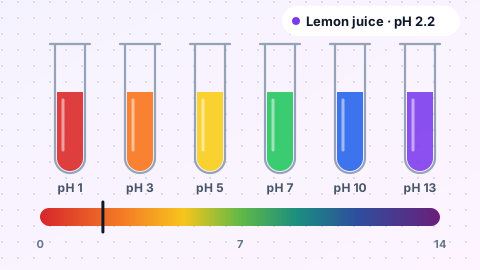
A universal indicator is a mixture of indicators that shows different colours for different pH values.
PH scale
The pH scale is a number scale from 0 to 14 that shows how acidic, neutral, or basic a solution is.
Tooth Decay
Tooth decay is the damage of tooth enamel caused when acids in the mouth lower the pH and slowly dissolve the hard outer layer.
Acid–Base Reactions
high priorityThe reaction families that come up in equation-writing questions.
The Salt Family
high priorityCommon salt and the four salts boards keep returning to: baking soda, washing soda, bleaching powder, POP.
Sodium Hydroxide
Sodium hydroxide is a strong base, also called caustic soda, that dissolves in water to give a highly basic solution.
Baking Soda
Baking soda is sodium hydrogen carbonate, a mild base used in cooking and as an antacid.
Washing Soda
Washing soda is sodium carbonate decahydrate, a basic salt used for cleaning and softening hard water.
Bleaching Powder
Bleaching powder is a chlorine-based compound used for bleaching and for disinfecting water.
Virtual lab
Acids, Bases and Salts simulation
Try the experiment yourself: change the values, see the result straight away, then check it against the NCERT book.
Exam Intelligence
The traps that cost marks in this chapter, and how its main concepts turn up in the paper.
Common Traps
- Calling every sour substance a strong acid.
- Treating pH 8 as neutral instead of basic.
- Using litmus when a full pH comparison is needed.
- Mixing up baking soda and washing soda.
- Forgetting that tooth decay is driven by acid produced by bacteria.
How CBSE Asks This Chapter
- Acid
Questions often ask for the indicator change, the meaning of low pH, or the correct identification of an acidic sample from a list of everyday substances.
- Base
Questions usually ask for the correct litmus change, the meaning of pH above 7, or the identification of a basic household solution.
- Neutralisation
Questions often ask for the reason antacids work, why acidic soil is treated with lime, or what products are formed in neutralisation.
- PH scale
Questions often compare two pH values, ask the nature of a solution, or connect pH with body fluids, soil, or toothpaste.
Quick Revision
Concept, formula or equation to remember, and the trap that loses marks — in one scannable view.
Remember
Acids release H+ ions in aqueous solution.Trap to avoid
Students often think every sour substance is a strong acid.
Remember
Bases give OH- ions in aqueous solution.Trap to avoid
Students often think every slippery liquid is an acid or that bases only appear in laboratories.
Remember
Acid + base → salt + water.Trap to avoid
Students sometimes write only salt is formed and forget water.
Remember
pH = -log10[H+].Trap to avoid
Students often think pH 6 and pH 3 are only slightly different.
Remember
Universal indicator gives a colour pattern across the pH scale, helping estimate whether a solution is acidic, neutral, or basic.Trap to avoid
Students often confuse universal indicator with litmus.
Remember
When mouth pH falls below about 5.5, enamel begins to dissolve more easily, so decay risk increases.Trap to avoid
Students often think tooth decay is only about dirty teeth.
Remember
NaOH dissolves in water to give Na+ and OH- ions.Trap to avoid
Students sometimes treat sodium hydroxide as a salt because it has sodium in the name.
Remember
Bleaching powder is commonly written as CaOCl2.Trap to avoid
Students often think bleaching powder is the same as ordinary detergent or liquid bleach.
Remember
Baking soda is NaHCO3.Trap to avoid
Students often confuse baking soda with washing soda.
Remember
Washing soda is Na2CO3·10H2O.Trap to avoid
Students often confuse washing soda with baking soda because both are white powders used in homes.
| Concept | Remember | Trap to avoid |
|---|---|---|
| Acid | Acids release H+ ions in aqueous solution. | Students often think every sour substance is a strong acid. |
| Base | Bases give OH- ions in aqueous solution. | Students often think every slippery liquid is an acid or that bases only appear in laboratories. |
| Neutralisation | Acid + base → salt + water. | Students sometimes write only salt is formed and forget water. |
| PH scale | pH = -log10[H+]. | Students often think pH 6 and pH 3 are only slightly different. |
| Universal Indicator | Universal indicator gives a colour pattern across the pH scale, helping estimate whether a solution is acidic, neutral, or basic. | Students often confuse universal indicator with litmus. |
| Tooth Decay | When mouth pH falls below about 5.5, enamel begins to dissolve more easily, so decay risk increases. | Students often think tooth decay is only about dirty teeth. |
| Sodium Hydroxide | NaOH dissolves in water to give Na+ and OH- ions. | Students sometimes treat sodium hydroxide as a salt because it has sodium in the name. |
| Bleaching Powder | Bleaching powder is commonly written as CaOCl2. | Students often think bleaching powder is the same as ordinary detergent or liquid bleach. |
| Baking Soda | Baking soda is NaHCO3. | Students often confuse baking soda with washing soda. |
| Washing Soda | Washing soda is Na2CO3·10H2O. | Students often confuse washing soda with baking soda because both are white powders used in homes. |
Practice
Use short concept checks first, then move into the full chapter test.
Free Chapter MCQ Quiz
Try a 15-question quiz from this chapter. Get instant score and unlock concept-wise analytics.
Help improve this page
Found something confusing, incorrect, or missing?