Chapter Hub
Our Environment
Our Environment chapter helps you understand how living organisms depend on one another and on air, water, soil, and sunlight. It also shows how food moves through nature, how waste affects the surroundings, and why careful waste management matters. For Class 10 exams, this chapter is usually asked through definitions, differences, reason-based questions, and simple application examples. A clear grip on ecosystem, food chain, food web, trophic level, waste handling, and ozone protection makes revision faster and answers more confident.
Difficulty
Medium
Study time
80-100 min
Plan by time
Pick the window that matches what you have right now.
If you have 15 min
Last-pass revision
Skim the Quick Revision table — definitions, formulas, and the traps board examiners reuse.
Open Quick RevisionIf you have 45 min
Targeted practice
Read the high-priority concepts, then take the chapter MCQ quiz to find weak spots.
Start MCQ QuizIf you have 80 min
First full pass
Walk every concept in chapter order, then revise and quiz. Best for the first time you study this chapter.
Open Key ConceptsChapter Learning Map
Start with one of the buckets below, then open the full map when you want the complete concept roadmap.
Ecosystem and food relations
Covers Ecosystem, Food Chain, Food Web, Trophic Level and Biological Magnification.
Open mapWaste and pollution management
Covers Biodegradable, Non-Biodegradable, Waste Segregation and Managing the Garbage we Produce.
Open mapAtmospheric protection
Covers Ozone Layer.
Open mapKey Concepts
Concepts grouped the way the chapter is taught — open the group that matches what you want to revise.
Ecosystem and food relations
high priorityCovers Ecosystem, Food Chain, Food Web, Trophic Level and Biological Magnification.
Ecosystem
An ecosystem is a place where living things and non-living things interact with one another as a working unit.
Food Chain
A food chain is a simple straight sequence that shows how food and energy pass from one organism to another.
Food Web
A food web is a network of many interconnected food chains in an ecosystem.
Trophic Level
A trophic level is each feeding position in a food chain or food web.
Biological Magnification
Biological magnification is the gradual increase in the concentration of harmful, non-biodegradable substances at higher trophic levels in a food chain.
Waste and pollution management
high priorityCovers Biodegradable, Non-Biodegradable, Waste Segregation and Managing the Garbage we Produce.
Biodegradable
Biodegradable substances are materials that can be broken down by microorganisms into simpler substances.
Non-Biodegradable
Non-biodegradable substances are materials that microorganisms cannot break down easily or quickly.
Waste Segregation
Waste segregation means separating different kinds of waste, such as wet waste, dry waste, and hazardous waste, at the place where it is produced.
Managing the Garbage we Produce
Managing the garbage we produce means reducing waste, reusing materials, recycling useful items, composting biodegradable waste, and disposing of harmful waste safely.
Atmospheric protection
medium priorityCovers Ozone Layer.
Virtual lab
Our Environment simulation
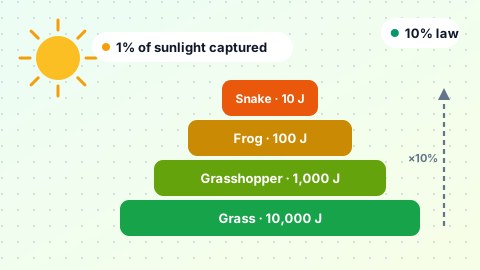
Try the experiment yourself: change the values, see the result straight away, then check it against the NCERT book.
Exam Intelligence
The traps that cost marks in this chapter, and how its main concepts turn up in the paper.
Common Traps
- Thinking an ecosystem contains only living organisms
- Reversing arrows in a food chain
- Calling every long chain a food web
- Counting trophic levels from the top predator instead of the producer
- Confusing physical breakup with microbial decomposition
- Assuming non-biodegradable waste disappears quickly
- Thinking biological magnification decreases toxin concentration upward
- Mixing ozone layer with oxygen supply
How CBSE Asks This Chapter
- Ecosystem
Define ecosystem, name its components, or explain why a pond or garden is an ecosystem.
- Food Chain
Complete a food chain, identify producer and consumers, or explain the effect of removing one link.
- Food Web
Explain a food web, compare it with a food chain, or interpret a diagram with many feeding arrows.
- Trophic Level
Identify the trophic level of an organism or explain why energy decreases at higher levels.
Quick Revision
Concept, formula or equation to remember, and the trap that loses marks — in one scannable view.
Remember
Ecosystem = biotic components + abiotic components + interactions among them.Trap to avoid
Students often think an ecosystem means only living organisms.
Remember
Food chain rule: energy flows from producer to consumer, and the arrow points from food to eater.Trap to avoid
Students often reverse the arrows.
Remember
Food web = many food chains joined together by common organisms and feeding links.Trap to avoid
Students often think a food web is just a longer food chain.
Remember
Trophic level rule: producers are first, primary consumers are second, secondary consumers are third, and so on.Trap to avoid
Students often confuse trophic level with the name of the organism.
Remember
Biodegradable = can be decomposed by microorganisms into simpler substances.Trap to avoid
Students often think anything that breaks into small pieces is biodegradable.
Remember
Non-biodegradable = not broken down quickly by microorganisms; it remains for a long time.Trap to avoid
Students sometimes think non-biodegradable means completely invisible or magically everlasting.
Remember
Biological magnification = concentration of a persistent toxin increases at successive trophic levels.Trap to avoid
Students often think the toxin amount stays the same at every level.
Remember
Ozone in the stratosphere absorbs UV radiation and helps protect life on Earth.Trap to avoid
Students often think the ozone layer produces oxygen for breathing.
Remember
Waste segregation rule: separate waste at source into suitable groups for composting, recycling, or safe disposal.Trap to avoid
Students often think segregation happens only at the garbage truck or landfill.
Managing the Garbage we Produce
Remember
Garbage management rule: Reduce, Reuse, Recycle, Compost, and dispose hazardous waste safely.Trap to avoid
Students often think garbage management means only throwing waste away carefully.
| Concept | Remember | Trap to avoid |
|---|---|---|
| Ecosystem | Ecosystem = biotic components + abiotic components + interactions among them. | Students often think an ecosystem means only living organisms. |
| Food Chain | Food chain rule: energy flows from producer to consumer, and the arrow points from food to eater. | Students often reverse the arrows. |
| Food Web | Food web = many food chains joined together by common organisms and feeding links. | Students often think a food web is just a longer food chain. |
| Trophic Level | Trophic level rule: producers are first, primary consumers are second, secondary consumers are third, and so on. | Students often confuse trophic level with the name of the organism. |
| Biodegradable | Biodegradable = can be decomposed by microorganisms into simpler substances. | Students often think anything that breaks into small pieces is biodegradable. |
| Non-Biodegradable | Non-biodegradable = not broken down quickly by microorganisms; it remains for a long time. | Students sometimes think non-biodegradable means completely invisible or magically everlasting. |
| Biological Magnification | Biological magnification = concentration of a persistent toxin increases at successive trophic levels. | Students often think the toxin amount stays the same at every level. |
| Ozone Layer | Ozone in the stratosphere absorbs UV radiation and helps protect life on Earth. | Students often think the ozone layer produces oxygen for breathing. |
| Waste Segregation | Waste segregation rule: separate waste at source into suitable groups for composting, recycling, or safe disposal. | Students often think segregation happens only at the garbage truck or landfill. |
| Managing the Garbage we Produce | Garbage management rule: Reduce, Reuse, Recycle, Compost, and dispose hazardous waste safely. | Students often think garbage management means only throwing waste away carefully. |
Practice
Use short concept checks first, then move into the full chapter test.
Free Chapter MCQ Quiz
Try a 15-question quiz from this chapter. Get instant score and unlock concept-wise analytics.
Help improve this page
Found something confusing, incorrect, or missing?