Chapter Hub
Metals and Non-metals
This chapter builds the basic comparison between metals and non-metals using everyday properties, chemical behaviour, and important uses. You should learn the reasons behind each property, not only the definitions. For Class 10 exam preparation, the chapter is important because questions often mix physical properties, reactivity, corrosion, alloys, ionic compounds, and oxide nature in one paper. A clear concept map helps in both short answers and MCQs.
Difficulty
Medium
Study time
80-100 min
Plan by time
Pick the window that matches what you have right now.
If you have 15 min
Last-pass revision
Skim the Quick Revision table — definitions, formulas, and the traps board examiners reuse.
Open Quick RevisionIf you have 45 min
Targeted practice
Read the high-priority concepts, then take the chapter MCQ quiz to find weak spots.
Start MCQ QuizIf you have 80 min
First full pass
Walk every concept in chapter order, then revise and quiz. Best for the first time you study this chapter.
Open Key ConceptsChapter Learning Map
Start with one of the buckets below, then open the full map when you want the complete concept roadmap.
Physical Properties
Covers Malleability, Ductility and Sonorous.
Open mapChemical Behaviour
Covers Reactivity Series, Ionic Compound, Non-Metal Oxides and Amphoteric Oxide.
Open mapApplications and Protection
Covers Rusting Prevention, Electrolytic Refining and Alloy.
Open mapKey Concepts
Concepts grouped the way the chapter is taught — open the group that matches what you want to revise.
Physical Properties
high priorityCovers Malleability, Ductility and Sonorous.
Malleability
Malleability is the property of a metal by which it can be beaten or rolled into thin sheets without breaking.
Ductility
Ductility is the property of a metal by which it can be drawn into wires without breaking.
Sonorous
Sonorous is the property of a metal by which it produces a ringing sound when struck.
Chemical Behaviour
high priorityCovers Reactivity Series, Ionic Compound, Non-Metal Oxides and Amphoteric Oxide.
Reactivity Series
The reactivity series is the arrangement of metals in decreasing order of their reactivity.
Ionic Compound
An ionic compound is a compound formed by attraction between oppositely charged ions.
Non-Metal Oxides
Non-metal oxides are usually acidic oxides formed when non-metals combine with oxygen.
Amphoteric Oxide
An amphoteric oxide is an oxide that reacts with both acids and bases.
Applications and Protection
medium priorityCovers Rusting Prevention, Electrolytic Refining and Alloy.
Rusting Prevention
Rusting prevention means stopping iron from coming into contact with both air and moisture.
Electrolytic Refining
Electrolytic refining is the method of obtaining a pure metal by using electricity in an electrolytic cell.
Alloy
An alloy is a homogeneous mixture of two or more metals, or a metal and a non-metal, made to improve useful properties.
Virtual lab
Metals and Non-metals simulation
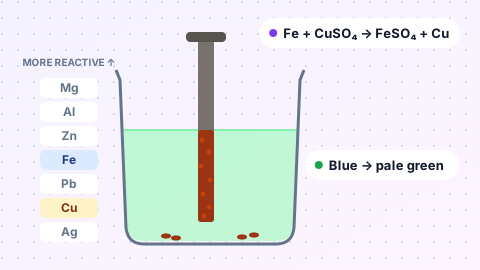
Try the experiment yourself: change the values, see the result straight away, then check it against the NCERT book.
Exam Intelligence
The traps that cost marks in this chapter, and how its main concepts turn up in the paper.
Common Traps
- Mixing malleability with ductility.
- Thinking solid ionic compounds conduct electricity.
- Forgetting that rusting needs both air and moisture.
- Calling every metal oxide basic without checking amphoteric exceptions.
- Reversing anode and cathode in electrolytic refining.
- Treating alloys as compounds instead of mixtures.
How CBSE Asks This Chapter
- Malleability
Questions usually ask which property allows a metal to become a sheet, or ask for examples such as aluminium foil and gold leaf.
- Ductility
The exam may ask for the property of metals used in making wires or may ask to distinguish ductility from malleability.
- Sonorous
Questions may ask for the property shown by bells, metal rods, or objects that ring on striking.
- Reactivity Series
Exam questions may ask which metal can displace another, which metal is more reactive, or why a particular metal is stored carefully.
Quick Revision
Concept, formula or equation to remember, and the trap that loses marks — in one scannable view.
Remember
metals that can be beaten into sheets are called malleable; this is a physical property, not a chemical change.Trap to avoid
Students often confuse malleability with ductility and think both mean the same thing in every case.
Remember
metals that can be drawn into wires are ductile; this is a physical property.Trap to avoid
Students sometimes call every shape change malleability, even when the metal is being drawn into a wire.
Remember
metals that produce a ringing sound on striking are called sonorous.Trap to avoid
Students sometimes assume every hard material is sonorous, but the property is specific to many metals, not all solids.
Remember
a more reactive metal displaces a less reactive metal from its compound or salt solution.Trap to avoid
Students often memorise the order but forget how to use it for displacement and extraction questions.
Remember
ionic compounds conduct electricity only when ions are free to move, such as in molten or aqueous state.Trap to avoid
Students often think an ionic solid conducts electricity because it contains ions, but the ions must be mobile to carry current.
Remember
rusting of iron needs both air and moisture; prevention methods block contact with one or both.Trap to avoid
Students often mention only air or only water, but rusting needs both air and moisture.
Remember
amphoteric oxides react with acids as well as bases; common examples are ZnO and Al2O3.Trap to avoid
Students often call every metal oxide basic, but some oxides like zinc oxide and aluminium oxide are amphoteric.
Remember
in electrolytic refining, the impure metal is the anode, the pure metal sheet is the cathode, and insoluble impurities form anode mud.Trap to avoid
Students often mix up anode and cathode roles or think all impurities move to the cathode.
Remember
an alloy is a mixture, not a compound, and it is formed to obtain better properties than the pure metal.Trap to avoid
Students often think an alloy is a compound, but it is usually a mixture with variable composition.
Remember
non-metal oxides are usually acidic; they may form acids in water or react with bases to give salt and water.Trap to avoid
Students sometimes think every oxide is basic, but non-metal oxides are generally acidic.
| Concept | Remember | Trap to avoid |
|---|---|---|
| Malleability | metals that can be beaten into sheets are called malleable; this is a physical property, not a chemical change. | Students often confuse malleability with ductility and think both mean the same thing in every case. |
| Ductility | metals that can be drawn into wires are ductile; this is a physical property. | Students sometimes call every shape change malleability, even when the metal is being drawn into a wire. |
| Sonorous | metals that produce a ringing sound on striking are called sonorous. | Students sometimes assume every hard material is sonorous, but the property is specific to many metals, not all solids. |
| Reactivity Series | a more reactive metal displaces a less reactive metal from its compound or salt solution. | Students often memorise the order but forget how to use it for displacement and extraction questions. |
| Ionic Compound | ionic compounds conduct electricity only when ions are free to move, such as in molten or aqueous state. | Students often think an ionic solid conducts electricity because it contains ions, but the ions must be mobile to carry current. |
| Rusting Prevention | rusting of iron needs both air and moisture; prevention methods block contact with one or both. | Students often mention only air or only water, but rusting needs both air and moisture. |
| Amphoteric Oxide | amphoteric oxides react with acids as well as bases; common examples are ZnO and Al2O3. | Students often call every metal oxide basic, but some oxides like zinc oxide and aluminium oxide are amphoteric. |
| Electrolytic Refining | in electrolytic refining, the impure metal is the anode, the pure metal sheet is the cathode, and insoluble impurities form anode mud. | Students often mix up anode and cathode roles or think all impurities move to the cathode. |
| Alloy | an alloy is a mixture, not a compound, and it is formed to obtain better properties than the pure metal. | Students often think an alloy is a compound, but it is usually a mixture with variable composition. |
| Non-Metal Oxides | non-metal oxides are usually acidic; they may form acids in water or react with bases to give salt and water. | Students sometimes think every oxide is basic, but non-metal oxides are generally acidic. |
Practice
Use short concept checks first, then move into the full chapter test.
Free Chapter MCQ Quiz
Try a 15-question quiz from this chapter. Get instant score and unlock concept-wise analytics.
Help improve this page
Found something confusing, incorrect, or missing?