Chapter Hub
Chemical Reactions and Equations
This chapter helps you understand how substances change during chemical reactions, how to identify the reaction type, and how to write the change in a clear equation form. The main focus is on oxidation, reduction, combination, decomposition, displacement, double displacement, precipitation, redox reactions, corrosion, and rancidity, with exam-style examples and common mistakes.
Difficulty
Medium
Study time
80-100 min
Plan by time
Pick the window that matches what you have right now.
If you have 15 min
Last-pass revision
Skim the Quick Revision table — definitions, formulas, and the traps board examiners reuse.
Open Quick RevisionIf you have 45 min
Targeted practice
Read the high-priority concepts, then take the chapter MCQ quiz to find weak spots.
Start MCQ QuizIf you have 80 min
First full pass
Walk every concept in chapter order, then revise and quiz. Best for the first time you study this chapter.
Open Key ConceptsChapter Learning Map
Start with one of the buckets below, then open the full map when you want the complete concept roadmap.
Reaction basics
Covers Oxidation, Reduction and Redox Reaction.
Open mapReaction patterns
Covers Combination Reaction, Decomposition Reaction, Displacement Reaction, Double Displacement Reaction and Precipitation Reaction.
Open mapEveryday effects
Covers Corrosion and Rancidity.
Open mapKey Concepts
Concepts grouped the way the chapter is taught — open the group that matches what you want to revise.
Reaction basics
high priorityCovers Oxidation, Reduction and Redox Reaction.
Oxidation
Oxidation is a change in which a substance gains oxygen, loses hydrogen, or loses electrons.
Reduction
Reduction is a change in which a substance loses oxygen, gains hydrogen, or gains electrons.
Redox Reaction
A redox reaction is a reaction in which oxidation and reduction happen at the same time.
Reaction patterns
high priorityCovers Combination Reaction, Decomposition Reaction, Displacement Reaction, Double Displacement Reaction and Precipitation Reaction.
Combination Reaction
A combination reaction is a reaction in which two or more substances combine to form one product.
Decomposition Reaction
A decomposition reaction is a reaction in which one compound breaks into two or more simpler substances.
Displacement Reaction
A displacement reaction is a reaction in which a more reactive element pushes out a less reactive element from its compound.
Double Displacement Reaction
A double displacement reaction is a reaction in which two compounds exchange ions to form two new compounds.
Precipitation Reaction
A precipitation reaction is a reaction in which an insoluble solid called a precipitate forms from solutions.
Everyday effects
medium priorityCovers Corrosion and Rancidity.
Virtual lab
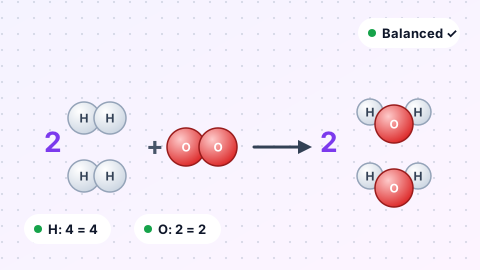
Chemical Reactions and Equations simulation
Try the experiment yourself: change the values, see the result straight away, then check it against the NCERT book.
Exam Intelligence
The traps that cost marks in this chapter, and how its main concepts turn up in the paper.
Common Traps
- Treating every heat-releasing reaction as combination.
- Forgetting that reduction can mean gain of electrons.
- Confusing displacement with double displacement.
- Ignoring the reactivity series in displacement reactions.
- Calling every solid-forming reaction decomposition.
- Mentioning only air or only moisture in rusting answers.
How CBSE Asks This Chapter
- Oxidation
Students may be asked to identify oxidation in a reaction, or to state whether oxygen is added or electrons are lost.
- Reduction
A question may ask which substance is reduced, or whether oxygen is removed or electrons are gained.
- Combination Reaction
Questions may ask you to identify the reaction type from an equation or from a real-life change that gives one product.
- Decomposition Reaction
Students may be asked to identify decomposition from a thermally broken compound or from electrolysis.
Quick Revision
Concept, formula or equation to remember, and the trap that loses marks — in one scannable view.
Remember
Oxidation = addition of oxygen, removal of hydrogen, or loss of electrons.Trap to avoid
Students often think oxidation means only adding oxygen, but electron loss is also an important sign of oxidation.
Remember
Reduction = removal of oxygen, addition of hydrogen, or gain of electrons.Trap to avoid
Students sometimes confuse reduction with loss of mass or with decomposition; those are different ideas.
Remember
General pattern: A + B → AB, often with heat or light released.Trap to avoid
Students think any reaction with heat is combination.
Remember
General pattern: AB → A + B, often needing heat, light, or electricity.Trap to avoid
Students sometimes think any reaction with one reactant is decomposition.
Remember
General pattern: A + BC → AC + B, when A is more reactive than B.Trap to avoid
Students often forget that the replacing element must be more reactive than the displaced one.
Remember
General pattern: AB + CD → AD + CB.Trap to avoid
Students may think only one substance changes.
Remember
A precipitate is an insoluble solid formed when aqueous ions combine to make an insoluble product.Trap to avoid
Students may write only the salt exchange and miss the insoluble solid formed in the reaction.
Remember
Redox = oxidation + reduction together in the same reaction.Trap to avoid
Students may describe only oxidation or only reduction and forget that both occur together.
Remember
Corrosion of iron needs oxygen from air and water or moisture; both together make rusting faster.Trap to avoid
Students often mention only air or only water.
Remember
Rancidity is oxidation of fats and oils; it is slowed by airtight packing, nitrogen, antioxidants, and refrigeration.Trap to avoid
Students often confuse rancidity with spoilage by germs only.
| Concept | Remember | Trap to avoid |
|---|---|---|
| Oxidation | Oxidation = addition of oxygen, removal of hydrogen, or loss of electrons. | Students often think oxidation means only adding oxygen, but electron loss is also an important sign of oxidation. |
| Reduction | Reduction = removal of oxygen, addition of hydrogen, or gain of electrons. | Students sometimes confuse reduction with loss of mass or with decomposition; those are different ideas. |
| Combination Reaction | General pattern: A + B → AB, often with heat or light released. | Students think any reaction with heat is combination. |
| Decomposition Reaction | General pattern: AB → A + B, often needing heat, light, or electricity. | Students sometimes think any reaction with one reactant is decomposition. |
| Displacement Reaction | General pattern: A + BC → AC + B, when A is more reactive than B. | Students often forget that the replacing element must be more reactive than the displaced one. |
| Double Displacement Reaction | General pattern: AB + CD → AD + CB. | Students may think only one substance changes. |
| Precipitation Reaction | A precipitate is an insoluble solid formed when aqueous ions combine to make an insoluble product. | Students may write only the salt exchange and miss the insoluble solid formed in the reaction. |
| Redox Reaction | Redox = oxidation + reduction together in the same reaction. | Students may describe only oxidation or only reduction and forget that both occur together. |
| Corrosion | Corrosion of iron needs oxygen from air and water or moisture; both together make rusting faster. | Students often mention only air or only water. |
| Rancidity | Rancidity is oxidation of fats and oils; it is slowed by airtight packing, nitrogen, antioxidants, and refrigeration. | Students often confuse rancidity with spoilage by germs only. |
Practice
Use short concept checks first, then move into the full chapter test.
Free Chapter MCQ Quiz
Try a 15-question quiz from this chapter. Get instant score and unlock concept-wise analytics.
Help improve this page
Found something confusing, incorrect, or missing?