Chapter Hub
Heredity and Evolution
Heredity explains how children get traits from their parents through genes. It helps you understand why family resemblance is common, why siblings are not exactly alike, and how traits are passed across generations in a predictable way. Evolution and natural selection explain how useful variations can become more common in a population over time. For CBSE Class 10, the chapter is usually asked through simple crosses, sex determination, differences among individuals, and reasoning-based questions on survival and inheritance.
Difficulty
Medium
Study time
70-90 min
Plan by time
Pick the window that matches what you have right now.
If you have 15 min
Last-pass revision
Skim the Quick Revision table — definitions, formulas, and the traps board examiners reuse.
Open Quick RevisionIf you have 45 min
Targeted practice
Read the high-priority concepts, then take the chapter MCQ quiz to find weak spots.
Start MCQ QuizIf you have 70 min
First full pass
Walk every concept in chapter order, then revise and quiz. Best for the first time you study this chapter.
Open Key ConceptsChapter Learning Map
Start with one of the buckets below, then open the full map when you want the complete concept roadmap.
Key Concepts
Concepts grouped the way the chapter is taught — open the group that matches what you want to revise.
Inheritance of traits
Covers Heredity, Gene, Dominant Trait, Recessive Trait, Monohybrid Ratio and Sex Determination.
Heredity
Heredity is the passing of traits from parents to their children through genes.
Gene
A gene is a small functional part of DNA on a chromosome that carries information for a trait.
Dominant Trait
A dominant trait is the trait that appears even when only one dominant allele is present.
Recessive Trait
A recessive trait is the trait that appears only when both alleles are recessive.
Monohybrid Ratio
The monohybrid ratio is the expected ratio of traits or genotypes when only one character is studied in a cross.
Sex Determination
Sex determination is the process by which the sex of an offspring is decided at fertilisation.
Differences and change
Covers Variation and Natural Selection.
Variation
Variation means differences among individuals of the same species.
Natural Selection
Natural selection is the process in which organisms with useful variations survive and reproduce more successfully in a particular environment.
Virtual lab
Heredity and Evolution simulation
Try the experiment yourself: change the values, see the result straight away, then check it against the NCERT book.
Exam Intelligence
The traps that cost marks in this chapter, and how its main concepts turn up in the paper.
Common Traps
- Confusing gene with chromosome.
- Thinking dominant means common or always better.
- Thinking recessive traits appear whenever the allele is present.
- Mixing genotype ratio with phenotype ratio.
- Saying the mother decides sex in humans.
- Treating variation as only environmental or only hereditary.
How CBSE Asks This Chapter
- Heredity
Explain heredity with an example, or state how traits are passed from parents to offspring in humans or plants.
- Gene
Define a gene, state its location, or explain why genes are called units of heredity.
- Dominant Trait
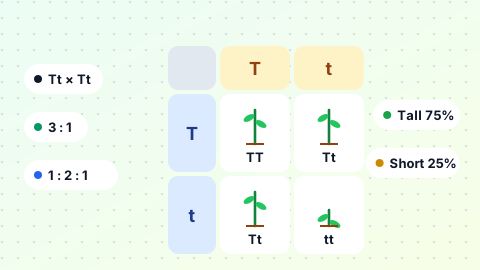
State why a trait appears in Tt, or identify the visible trait in a heterozygous cross.
- Recessive Trait
Identify the visible trait in a recessive condition, or explain why a recessive trait may be hidden in a heterozygote.
Quick Revision
Concept, formula or equation to remember, and the trap that loses marks — in one scannable view.
Remember
Traits are inherited from parents to offspring through genes; heredity is the transfer of genetic information across generations.Trap to avoid
Students often think heredity means the child must look exactly like one parent.
Remember
A gene is a segment of DNA on a chromosome; many genes together make up a chromosome.Trap to avoid
Students often say gene and chromosome are the same.
Remember
A dominant allele expresses itself in a heterozygous condition and masks the recessive allele in the phenotype.Trap to avoid
Students often think dominant means more common or stronger in every situation.
Remember
A recessive trait is expressed only in homozygous recessive condition and is masked by a dominant allele in heterozygous condition.Trap to avoid
Students often think recessive means weak or rare in every case.
Remember
For Tt x Tt, genotype ratio = 1 TT : 2 Tt : 1 tt, and phenotype ratio = 3 dominant : 1 recessive.Trap to avoid
Students often mix genotype ratio with phenotype ratio.
Remember
Human sex chromosomes: female = XX, male = XY; egg always carries X, sperm carries X or Y.Trap to avoid
Students often think the mother decides the sex of the baby.
Remember
Variation may be inherited, environmental, or a combination of both.Trap to avoid
Students often think all differences are due to heredity alone.
Remember
Natural selection favours variations that improve survival and reproduction in a given environment.Trap to avoid
Students sometimes think individual organisms change their traits because they need to survive.
| Concept | Remember | Trap to avoid |
|---|---|---|
| Heredity | Traits are inherited from parents to offspring through genes; heredity is the transfer of genetic information across generations. | Students often think heredity means the child must look exactly like one parent. |
| Gene | A gene is a segment of DNA on a chromosome; many genes together make up a chromosome. | Students often say gene and chromosome are the same. |
| Dominant Trait | A dominant allele expresses itself in a heterozygous condition and masks the recessive allele in the phenotype. | Students often think dominant means more common or stronger in every situation. |
| Recessive Trait | A recessive trait is expressed only in homozygous recessive condition and is masked by a dominant allele in heterozygous condition. | Students often think recessive means weak or rare in every case. |
| Monohybrid Ratio | For Tt x Tt, genotype ratio = 1 TT : 2 Tt : 1 tt, and phenotype ratio = 3 dominant : 1 recessive. | Students often mix genotype ratio with phenotype ratio. |
| Sex Determination | Human sex chromosomes: female = XX, male = XY; egg always carries X, sperm carries X or Y. | Students often think the mother decides the sex of the baby. |
| Variation | Variation may be inherited, environmental, or a combination of both. | Students often think all differences are due to heredity alone. |
| Natural Selection | Natural selection favours variations that improve survival and reproduction in a given environment. | Students sometimes think individual organisms change their traits because they need to survive. |
Practice
Use short concept checks first, then move into the full chapter test.
Free Chapter MCQ Quiz
Try a 15-question quiz from this chapter. Get instant score and unlock concept-wise analytics.
Help improve this page
Found something confusing, incorrect, or missing?