Refraction Through a Glass Slab
Change the angle of incidence and the material to see Snell's law and lateral displacement.
- NCERT Activity 9.10 (rectangular glass slab)
- Table 9.3 (absolute refractive index)
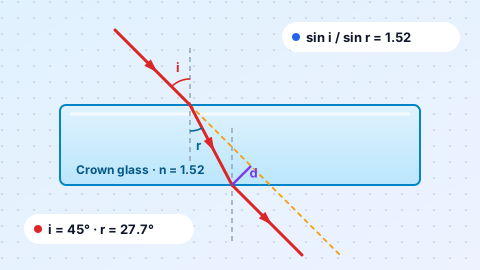
Drag the red handle, or anywhere above the slab, to change the angle of incidence. Drag the grip on the bottom face to change the thickness.
Angle of refraction r
25°
Angle of emergence e
40°
sin i / sin r
1.52
Equals n for every angle
Lateral shift d
1.14 cm
Speed of light in slab
1.97 × 10⁸ m/s
v = c / n
The dotted orange line is the incident ray produced through the slab. The violet line d is the lateral displacement.
About the Refraction Through a Glass Slab
Trace the path of a ray of light through a rectangular glass slab exactly as in the CBSE Class 10 practical, without pins and paper. Change the angle of incidence, the material of the slab and its thickness, and the simulation draws the incident ray, refracted ray, emergent ray and normals for you.
Live readings of the angle of refraction, the angle of emergence, sin i / sin r and the lateral displacement help you verify Snell's law and see why the emergent ray is parallel to the incident ray. Refractive indices are taken from NCERT Table 9.3.
CBSE Class 10 practical
Tracing the path of a ray of light through a rectangular glass slab for different angles of incidence, and measuring the angles of incidence, refraction and emergence.
Try this
- 1Set i = 0°. Why does the ray pass straight through without bending?
- 2Keep i = 45° and change from water to diamond. What happens to r and the lateral shift?
- 3Double the slab thickness. How does the lateral displacement change?
What you will learn
- Trace the incident, refracted and emergent rays through a glass slab.
- Verify that sin i / sin r is constant for a given pair of media.
- Explain why the emergent ray is parallel to the incident ray but shifted sideways.
Key ideas
- Snell's law
- sin i / sin r = n, the refractive index of the slab with respect to air.
- Speed of light
- n = c / v, so light travels slowest in the medium with the highest refractive index.
Board exam tip
Light bends towards the normal when it enters an optically denser medium and away from it when it leaves.
Frequently asked questions
Why is the emergent ray parallel to the incident ray in a glass slab?
The two refracting faces of the slab are parallel, so the bending at the second face exactly reverses the bending at the first. The angle of emergence equals the angle of incidence.
What is lateral displacement?
It is the perpendicular distance between the incident ray produced forward and the emergent ray. It is larger for a thicker slab, a larger angle of incidence and a higher refractive index.
What is Snell's law of refraction?
For a given pair of media and a given colour of light, sin i / sin r is a constant called the refractive index of the second medium with respect to the first. For crown glass it is about 1.52.