Myopia and Hypermetropia Correction Lab
See where the image forms inside a defective eye, then add the right spectacle lens to focus it on the retina.
- NCERT Figures 10.2 (myopia) and 10.3 (hypermetropia)
- Near point and far point of the eye
Drag the book closer or farther away. Tap in front of the eye to put the spectacles on or take them off.
Simplified eye: lens to retina 2.3 cm and spectacles close to the eye. Distances outside the eye are not to scale and the focus shift is drawn 4× larger.
Object distance
Very far (∞)
Far point
80 cm
Near point
19 cm
Image forms
0.64 mm in front of the retina
Corrective lens
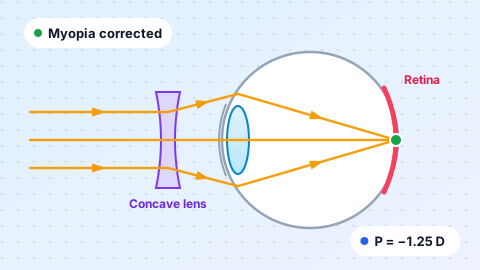
Concave lens, f = −80 cm, P = −1.25 D
About the Myopia and Hypermetropia Correction Lab
This human eye simulation shows where the image forms in a normal eye, a myopic (short-sighted) eye and a hypermetropic (long-sighted) eye, the defects of vision in CBSE Class 10 The Human Eye and the Colourful World. Change the far point or near point and watch the image move in front of or behind the retina.
Switch on corrective spectacles to see how a concave lens corrects myopia and a convex lens corrects hypermetropia. The simulation calculates the focal length and power of the lens in dioptres, so you can check answers to NCERT numericals such as a far point of 80 cm or a near point of 1 m.
Try this
- 1Set a far point of 80 cm and switch on correction. Check that P = −1.25 D.
- 2Set a near point of 1 m and look at a book at 25 cm. What power corrects it?
- 3Wear the hypermetropia glasses and look at a distant object. Why do some people need bifocals?
What you will learn
- Explain where the image forms in myopic and hypermetropic eyes.
- Choose a concave or convex lens to correct each defect.
- Calculate the power of the corrective lens from the far or near point.
Key ideas
- Myopia
- Image of a distant object forms in front of the retina. A concave lens with f = −(far point) corrects it.
- Hypermetropia
- Image of a near object forms behind the retina. A convex lens makes an object at 25 cm appear at the near point.
Board exam tip
Use P = 1/f with f in metres. A concave lens has negative power and a convex lens has positive power.
Frequently asked questions
Which lens is used to correct myopia?
A concave (diverging) lens of suitable power. For a far point of 80 cm, the lens has a focal length of −80 cm and a power of −1.25 D.
How is hypermetropia corrected?
With a convex (converging) lens that makes an object at 25 cm appear to be at the person's near point. For a near point of 1 m, the lens has a power of +3 D.
What are the near point and far point of a normal eye?
For a young adult with normal vision, the near point is about 25 cm and the far point is at infinity.