Ohm's Law and Resistor Combinations Lab
Add cells, connect resistors in series or parallel and read the ammeter and voltmeter.
- NCERT Activity 11.1 (Ohm's law)
- Activities 11.4–11.6 (resistors in series and parallel)
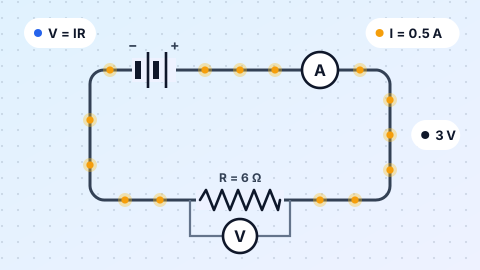
Drag a resistor sideways to change its resistance, or drag the battery to add or remove cells. Tap the key to open or close the circuit.
Battery
3 V
Equivalent resistance
6 Ω
Ammeter
0.5 A
Power used
1.5 W
P = VI
| Cells | V (V) | I (A) | V / I (Ω) |
|---|---|---|---|
| Press “Record reading” for different numbers of cells. | |||
V–I graph
Blue line: V = IR for the present resistors. Recorded readings are shown as dots.
About the Ohm's Law and Resistor Combinations Lab
This Ohm's law virtual lab follows the CBSE Class 10 Electricity practicals. Add cells, choose resistor values and read the ammeter and voltmeter, then record your readings to plot a V–I graph and check that V / I stays constant for a resistor.
Connect two resistors in series or in parallel to compare how current and voltage divide, find the equivalent resistance and calculate the electric power. Moving charges show the direction of conventional current, and opening the plug key breaks the circuit.
CBSE Class 10 practical
Studying how the potential difference (V) across a resistor depends on the current (I) and plotting a V–I graph, and finding the equivalent resistance of two resistors in series and in parallel.
Try this
- 1Record readings for 1, 2, 3 and 4 cells. Is V/I the same every time?
- 2Connect 6 Ω and 3 Ω in parallel. Predict the equivalent resistance before you look.
- 3Open the plug key. What do the ammeter and voltmeter read now?
What you will learn
- Verify Ohm's law by recording voltage and current for different numbers of cells.
- Compare current and voltage in series and parallel combinations.
- Calculate equivalent resistance and electric power.
Key ideas
- Ohm's law
- V = IR. The V–I graph of a resistor at constant temperature is a straight line through the origin.
- Combinations
- Series: R = R1 + R2 (same current). Parallel: 1/R = 1/R1 + 1/R2 (same voltage).
Board exam tip
The equivalent resistance of a parallel combination is always less than the smallest resistance in it.
Frequently asked questions
What is Ohm's law?
At constant temperature, the current through a conductor is directly proportional to the potential difference across its ends: V = IR, where R is the resistance.
How do you find equivalent resistance in series and parallel?
In series, add the resistances: R = R1 + R2. In parallel, add the reciprocals: 1/R = 1/R1 + 1/R2. For 6 Ω and 3 Ω, series gives 9 Ω and parallel gives 2 Ω.
What does the slope of a V–I graph show?
With V on the vertical axis and I on the horizontal axis, the slope of the straight line is the resistance R of the conductor.