pH Scale and Indicator Lab
Test everyday solutions with litmus, phenolphthalein, methyl orange, turmeric and universal indicator.
- NCERT Table 2.1 (indicators)
- Activity 2.11 and Figure 2.7 (pH of common substances)
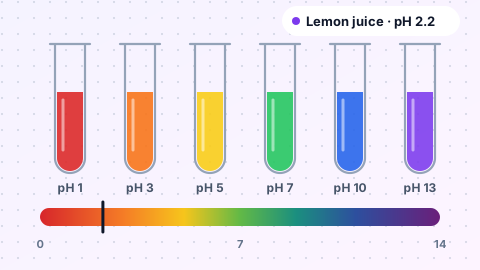
Drag along the pH scale to see every indicator change colour, or tap a solution.
Blue litmus
Turns red
Red litmus
No change
Phenolphthalein
Colourless
Methyl orange
Red
Turmeric
Stays yellow
Universal indicator
pH ≈ 2
pH
2.2
NCERT Figure 2.7
Nature
Acidic
[H+] concentration
10−2.2 mol/L
63,096 times more H+ ions than pure water
Indicators change colour over a range of pH, so solutions close to neutral may give only a faint litmus change. Values marked “typical” vary between real samples.
About the pH Scale and Indicator Lab
This pH scale simulation is a virtual version of the CBSE Class 10 Acids, Bases and Salts practical. Choose a solution such as lemon juice, gastric juice, blood or milk of magnesia and see how blue litmus, red litmus, phenolphthalein, methyl orange, turmeric and universal indicator respond.
Slide along the pH scale from 0 to 14 to see where each indicator changes colour and how the hydrogen ion concentration changes tenfold with every pH unit. Solutions marked with a green dot are the six samples named in the CBSE practical list.
CBSE Class 10 practical
Finding the pH of dilute hydrochloric acid, dilute sodium hydroxide, dilute ethanoic acid, lemon juice, water and dilute sodium hydrogencarbonate solution using pH paper or universal indicator.
Try this
- 1Test pure water. Which indicators show no change at all?
- 2Compare coffee (pH 5) with lemon juice (pH 2.2). How many times more H+ ions does lemon juice have?
- 3Drag the pH slider from 7 to 14 and note where phenolphthalein first turns pink.
What you will learn
- Predict the colour of common indicators in acids, bases and neutral solutions.
- Read the pH of a solution from the universal indicator colour.
- Relate pH to the concentration of hydrogen ions.
Key ideas
- pH scale
- pH 7 is neutral, below 7 is acidic and above 7 is basic. Each step of 1 is a tenfold change in H+ ion concentration.
- Indicator ranges
- Indicators change colour over a pH range, so solutions close to neutral may give only a faint litmus change.
Board exam tip
Tooth decay starts below pH 5.5 and acid rain has pH below 5.6. Both are common 1-mark questions.
Frequently asked questions
What is the pH of lemon juice, water and milk of magnesia?
In NCERT Figure 2.7, lemon juice has a pH of about 2.2, pure water 7 and milk of magnesia about 10. Lemon juice is acidic, water is neutral and milk of magnesia is basic.
What colour does phenolphthalein turn in acids and bases?
Phenolphthalein stays colourless in acidic and neutral solutions and turns pink in basic solutions, so it is used to detect bases such as sodium hydroxide.
Why does a weak acid sometimes not change litmus clearly?
Litmus changes colour over a range of roughly pH 4.5 to 8.3, so a solution close to pH 7, such as milk, may give only a faint change. pH paper or universal indicator gives a clearer reading.