Chemical Equation Balancer
Change coefficients and watch atoms on both sides of the arrow until mass is conserved.
- NCERT Chapter 1: balancing the reaction of iron with steam
- Types of chemical reactions
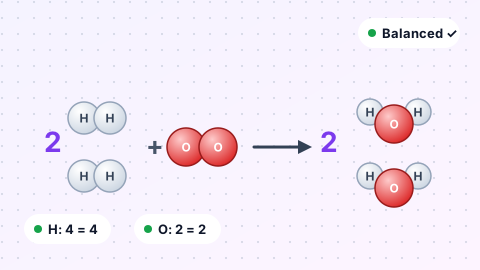
Tap a formula to add one more of it (after 9 it goes back to 1), or use the − and + buttons.
Combination reaction
Burning magnesium ribbon
| Atom | Reactants | Products | Balanced |
|---|---|---|---|
| Mg | 1 | 1 | Balanced |
| O | 2 | 1 | Not balanced |
Magnesium burns with a dazzling white flame to form white magnesium oxide powder.
About the Chemical Equation Balancer
Balancing chemical equations is the first skill tested in CBSE Class 10 Chemical Reactions and Equations. This free online equation balancer lets you change the coefficients of NCERT reactions and instantly see whether the atoms of each element are equal on both sides of the arrow, so you can practise the hit-and-trial method step by step.
It covers combination, decomposition, displacement, double displacement, neutralisation, combustion and redox reactions, including all four reactions in the CBSE Class 10 practical list. Use a hint when you are stuck, then write the balanced equation with state symbols, just as board examiners expect.
CBSE Class 10 practical
Performing and classifying four reactions: quicklime with water, heating ferrous sulphate crystals, iron nails in copper sulphate, and sodium sulphate with barium chloride.
Try this
- 1Start with “Iron with steam”. Balance Fe3O4 first because it has the most atoms.
- 2Double every coefficient of a balanced equation. Why does the lab ask you to reduce it?
- 3Balance the lead nitrate equation and count oxygen carefully inside the bracket.
What you will learn
- Apply the law of conservation of mass to a chemical equation.
- Balance equations by the hit-and-trial method used in NCERT.
- Recognise combination, decomposition, displacement and redox reactions.
Key ideas
- Conservation of mass
- Atoms are neither created nor destroyed, so each element must have the same number of atoms on both sides.
- Change only coefficients
- Never change a subscript. H2O2 is a different substance from H2O.
Board exam tip
Board answers lose marks for missing state symbols. Write (s), (l), (g) or (aq) after balancing.
Frequently asked questions
How do you balance a chemical equation in Class 10?
Write the skeletal equation, count the atoms of each element on both sides, and change only the coefficients until every element balances. Start with the compound that has the most atoms, balance free elements such as O₂ or H₂ last, and check that the coefficients are the smallest whole numbers.
Why can't we change subscripts to balance an equation?
Subscripts are part of the formula of a substance. Changing H₂O to H₂O₂ turns water into hydrogen peroxide, a different compound. Only the coefficients in front of the formulae can change.
Which types of reactions are included?
Combination, thermal and photolytic decomposition, displacement, double displacement (precipitation), neutralisation, combustion, respiration and redox reactions from the NCERT Class 10 chapter.