Energy Flow and the 10% Law
Follow sunlight through a food chain and watch energy fall while harmful chemicals build up.
- NCERT Chapter 13: food chains and the flow of energy
- Biological magnification
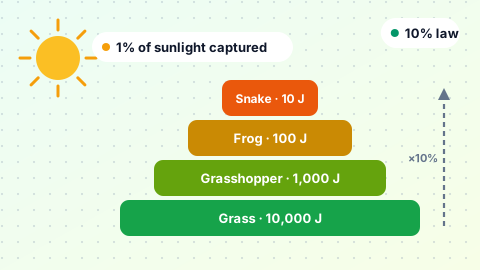
Tap or hover over a level of the pyramid to compare its energy with the producers'.
Producers capture about 1% of it.
- T1 · Producer
- T2 · Primary consumer (herbivore)
- T3 · Secondary consumer
- T4 · Tertiary consumer
- T5 · Quaternary consumer
Tap or hover over a level to inspect it.
Bar widths use a log scale; the real drop is much steeper.
Biological magnification
A pesticide that is not broken down builds up at each level.
- Grass1×
- Grasshopper5×
- Frog25×
- Snake125×
- Eagle625×
Concentrations are relative to the producers and are illustrative.
Producers get
10,000 J
Eagle gets
1 J
Reaches the top
0.01%
of the producers' energy
Pesticide in top level
625×
About the Energy Flow and the 10% Law
This energy flow simulation explains the 10 percent law from CBSE Class 10 Our Environment. Choose a grassland, forest or pond food chain and follow the sunlight from the producers to the top consumers, with the energy at every trophic level worked out for you.
Change the share of energy passed on to see why food chains rarely have more than four steps, and increase the build-up of a pesticide to understand biological magnification and why top predators are affected most.
Try this
- 1With 10,00,000 J of sunlight, how much energy reaches the snake?
- 2Change the transfer efficiency to 20%. Does the top predator get twice as much energy?
- 3Increase the concentration factor. Which organism is harmed most by pesticides?
What you will learn
- Calculate the energy available at each trophic level using the 10% law.
- Explain why food chains usually have only three or four steps.
- Explain biological magnification of non-biodegradable chemicals.
Key ideas
- Energy capture
- Green plants capture about 1% of the sunlight that falls on their leaves.
- 10% law
- On average only 10% of the energy at one trophic level is available to the next.
Board exam tip
Energy flow is unidirectional: energy passed to herbivores never returns to the producers.
Frequently asked questions
What is the 10 percent law?
On average, only about 10% of the energy at one trophic level is available to the next level. The rest is lost as heat or used in the organism's own life processes.
How much sunlight do green plants capture?
Green plants in a terrestrial ecosystem capture about 1% of the energy of the sunlight that falls on their leaves.
What is biological magnification?
It is the increase in concentration of non-biodegradable chemicals, such as some pesticides, at each higher trophic level of a food chain. Organisms at the top have the highest concentration.